

TeamSpeak was more or less dead. Not officially, but in practice: since Discord took over gaming communication around 2016-2017, TeamSpeak had become the software veterans kept out of habit and new players no longer even installed. The interface dated from another era, features had barely evolved in ten years, and the paid model for servers seemed out of step with a Discord that was entirely free for the basic user.
Then two things happened in early 2026 that completely relaunched the platform. First, TeamSpeak released the TeamSpeak 6 beta with a major client overhaul. Then, Discord announced mandatory identity verification with a face scan or government ID, which triggered a mass exodus of users toward alternatives. TeamSpeak found itself with such a large influx that its servers saturated in several regions, notably in the United States. For a platform everyone considered finished, that is a remarkable turnaround.
What triggered the Discord exodus
In February 2026, Discord announced the worldwide rollout of a mandatory age verification system starting in March. To access the platform's full features, users would now be required to confirm their age via a face scan or an official identity document. Discord justified this decision by compliance with child protection regulations, notably the British Online Safety Act, and by the aim of creating a "teen-appropriate experience" by default.
The users' reaction was immediate and fierce. The problem was not only the verification itself. In October 2025, Discord had suffered a data leak that compromised the ID documents of roughly 70,000 users. Asking people to send their ID card or a scan of their face a few months after such a security incident is the kind of decision that pushes even the most loyal users to look for an exit.
On February 14, 2026, TeamSpeak published a message on X (formerly Twitter) confirming an "incredible influx of new users" that had saturated hosting capacity in several regions. The platform had to urgently open new server instances in Frankfurt and Toronto to absorb the demand. TeamSpeak was not the only alternative to benefit from this exodus (Revolt, renamed Stoat, saw the same phenomenon), but TeamSpeak captured the largest share of the flow, largely thanks to the timing of the TS6 release.
TeamSpeak 6: what actually changes
TeamSpeak 6 is the most significant update of the software since its creation. The client was completely rebuilt, not just restyled. The beta came out on January 21, 2025, and development continues actively in 2026 (server beta 11 dates from June 2026).
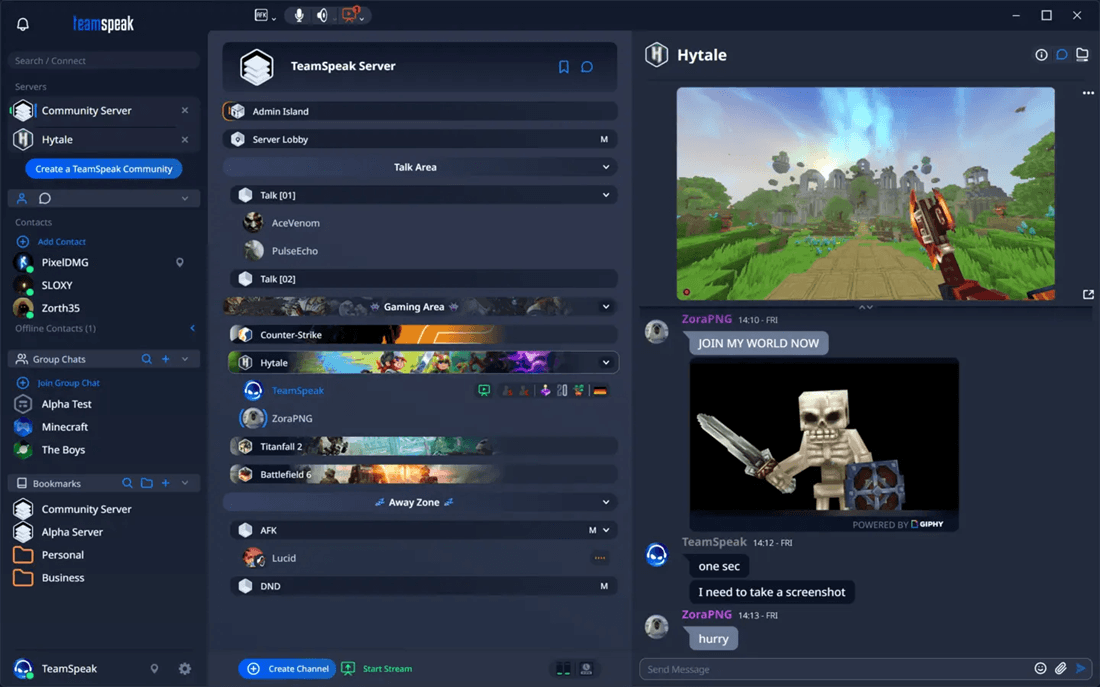
The interface was modernized from top to bottom. The old TS3 client, with its Windows XP application look, gave way to a responsive, clean design with resizable panels and intuitive navigation. We are still far from Discord's polish, but the gap has narrowed considerably. Ergonomics is no longer a deal-breaker argument against TeamSpeak.
Screen sharing is probably the most awaited feature. TeamSpeak 6 supports screen, game and webcam sharing in quality up to 1440p at 60 FPS (4K and native resolution are being rolled out). Encoding is GPU-accelerated, which minimizes the impact on game performance. And unlike Discord, high-quality screen sharing is free, not reserved for Nitro subscribers.
One-on-one direct calls are in active development. For the first time in TeamSpeak's history, it will be possible to contact someone directly without going through a server. This is a feature Discord has offered since its beginnings, and its absence on TeamSpeak was a major obstacle for users used to that simplicity.
Picture-in-picture mode lets you display up to 4 streams (screen shares or cameras) at once in a call window, positioning them freely. It is useful for coaching sessions, group streaming, or simply keeping an eye on several things at once.
On the hosting side, TeamSpeak 6 offers buying hosted servers directly from the app, which considerably simplifies access for users who do not want to run a server themselves. The TeamSpeak server can also be self-hosted via Docker for those who prefer to keep control.
What TeamSpeak keeps that Discord does not have
TeamSpeak's 2026 repositioning rests on one central argument: privacy. TeamSpeak presents itself as a "privacy-first", decentralized and secure platform. No identity verification. No face scan. No usage data collection for targeted advertising. No behavioral profiling. For gaming communities that handle sensitive data, guild information, or simply people who do not want to hand their ID to a company, this argument carries weight.
The server model remains fundamentally different from Discord's. With TeamSpeak, you own your server. You can host it at home, on your own machine, without depending on any third-party infrastructure. The data stays on your server, not on TeamSpeak's servers. This decentralized model is what many communities have always appreciated, and it is exactly what Discord does not offer.
Audio quality remains a historic strength. TeamSpeak uses the Opus codec with very low latency, and longtime users report vocal quality superior to Discord, especially in competitive gaming environments where every millisecond of latency counts. The granular permission system is also more powerful than Discord's: you can configure extremely precise rights per user, per group, per channel, with a level of finesse that Discord roles do not allow.
What TeamSpeak 6 still lacks
It would be dishonest to present TeamSpeak 6 as a complete replacement for Discord in 2026. Several aspects are still lagging.
The bot and integration ecosystem is incomparably less rich. Discord has thousands of bots covering moderation, music, games, polls, community management, webhooks and integration with nearly every online service imaginable. TeamSpeak 3 had a plugin system, but most plugins are not compatible with TS6. The ecosystem will need to be rebuilt.
Social features are rudimentary compared to Discord. No rich profile system, no elaborate custom statuses, no built-in forum channels, no community event system with RSVP. Discord built a real social network around voice and text communication. TeamSpeak remains above all a communication tool, not a social platform.
The user base, despite the February 2026 influx, remains incomparably smaller than Discord's. Convincing an entire community to migrate from one platform to another is a slow and painful process. Even users dissatisfied with Discord often hesitate to take the step because "everyone is on Discord".
Who is TeamSpeak 6 for in 2026?
TeamSpeak 6 is not for everyone, and that is probably its strength. The target audience is fairly clear: competitive gaming guilds and clans who want minimal latency and flawless audio quality. Communities that prioritize privacy and control of their data. Server administrators who want an advanced permission system and the ability to self-host. Players who refuse the identity verification imposed by Discord. And TeamSpeak 3 nostalgics who were waiting for a reason to come back.
For casual communities, groups of friends who just want somewhere to chat while playing, or content creators who need Discord's ecosystem of bots and integrations, TeamSpeak 6 is probably not the right choice in 2026. Not yet, at least.
| Criterion | TeamSpeak 6 | Discord |
|---|---|---|
| Privacy | No identity verification, self-hosting possible, data on your server | Mandatory identity verification (March 2026), data on Discord servers |
| Screen sharing | Free up to 1440p/60 FPS, 4K in progress | 720p/30 FPS free, higher quality reserved for Nitro |
| Audio quality | Opus, very low latency, reputed superior | Opus, good quality, slightly higher latency |
| Bots and integrations | Limited ecosystem, being rebuilt | Thousands of bots, massive integrations |
| Social features | Basic (chat, voice, sharing) | Full social network (profiles, statuses, events, forums) |
| Server hosting | Self-hosted or hosted via TeamSpeak, total control | Hosted by Discord only |
| Permissions | Very advanced granular system | Simple role system but sufficient for most |
| Cost | Free client, paid server or self-hosted | Free, Nitro for premium features |
TeamSpeak 6 is not a strong comeback in the sense that it will replace Discord. That is not what is happening, and it would not be realistic to claim it. But it is a return to relevance. By combining a technical overhaul awaited for years (screen sharing, modern interface, direct calls) with a privacy-first positioning that lands at exactly the right time (Discord's identity verification threw hundreds of thousands of users into its arms), TeamSpeak regains a role in the gaming communication ecosystem. For communities that want control of their data, minimal latency and a powerful permission system, TeamSpeak 6 has become a credible option again. And nobody would have predicted that two years ago.
Discover TeamSpeak servers
Find your next TeamSpeak server in our ranking.

No comments yet.